Vacancy – Member of the Independent Remuneration Panel
Do you feel you have the time and the skills to make a positive contribution to the County Council’s Independent Remuneration Panel?
Broadband Explained
Gloucestershire County Council defines superfast broadband as 30 megabits per second (Mbps), while some organisations consider 24Mbps superfast. Superfast speeds generally range up to approximately 80Mbps. Ultrafast broadband is widely defined as offering download speeds of 100 Mbps and above. Gigabit broadband is the next step up in broadband speeds, with download speeds starting at 1000 Mbps.
Asymmetric Digital Subscriber Line (ADSL)

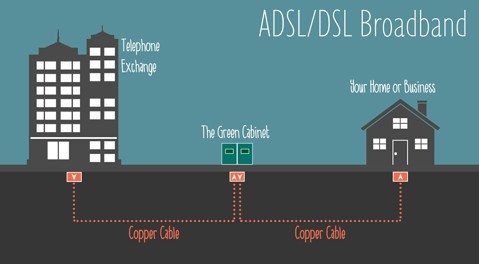
ADSL offers download speeds of up to 24Mbps and upload speeds of 1.2Mbps, providing faster connection speeds than dial-up services. However, due to the use of copper wire, speeds decline the further you live from the telephone exchange. ADSL technology includes three different types: ADSL, ADSL2, and ADSL2+.
Asymmetric Digital Subscriber Line (ADSL)

ADSL offers download speeds of up to 24Mbps and upload speeds of 1.2Mbps, providing faster connection speeds than dial-up services. However, due to the use of copper wire, speeds decline the further you live from the telephone exchange. ADSL technology includes three different types: ADSL, ADSL2, and ADSL2+.
Fibre broadband utilises fibre optic cables, which can carry much more data than ADSL. There are two main types of fibre broadband:
Fibre to the Cabinet (FTTC)
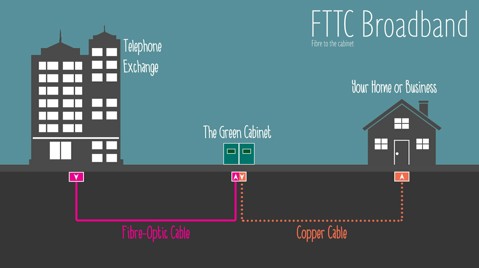
FTTC uses fibre optic cables to connect local street-side cabinets, but existing copper wires are still used to make the final connection from the cabinet to the property. FTTC can offer superfast broadband, allowing for multiple connected devices, online shopping, home working, and streaming. However, speeds decrease the further your property is from the cabinet, resulting in varying speeds for properties connected to the same cabinet.
Full Fibre / Fibre to the Premise (FTTP)
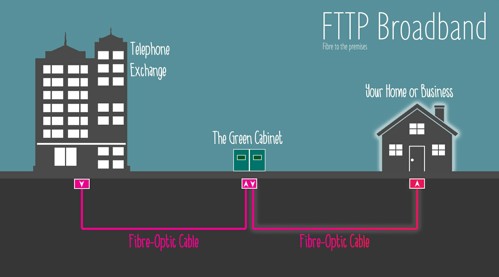
Full fibre is a 100% fibre connection that allows access to a gigabit-capable fibre connection straight to your home, regardless of the distance from the cabinet. FTTP is ideal for businesses, large families, and online gaming, and it typically offers symmetrical speeds where your upload speed is the same as your download speed.
Coverage for FTTP only extends across some of the UK, and building new networks is very expensive. These high costs make it financially unviable for commercial broadband suppliers to build networks in sparsely populated rural areas. To address these hard-to-reach areas, the UK Government launched Project Gigabit, a £5 billion program to enable communities to access lightning-fast gigabit-capable broadband.
Fibre broadband utilises fibre optic cables, which can carry much more data than ADSL. There are two main types of fibre broadband:
Fibre to the Cabinet (FTTC)

FTTC uses fibre optic cables to connect local street-side cabinets, but existing copper wires are still used to make the final connection from the cabinet to the property. FTTC can offer superfast broadband, allowing for multiple connected devices, online shopping, home working, and streaming. However, speeds decrease the further your property is from the cabinet, resulting in varying speeds for properties connected to the same cabinet.
Full Fibre / Fibre to the Premise (FTTP)

Full fibre is a 100% fibre connection that allows access to a gigabit-capable fibre connection straight to your home, regardless of the distance from the cabinet. FTTP is ideal for businesses, large families, and online gaming, and it typically offers symmetrical speeds where your upload speed is the same as your download speed.
Coverage for FTTP only extends across some of the UK, and building new networks is very expensive. These high costs make it financially unviable for commercial broadband suppliers to build networks in sparsely populated rural areas. To address these hard-to-reach areas, the UK Government launched Project Gigabit, a £5 billion program to enable communities to access lightning-fast gigabit-capable broadband.
Broadband connections can also be delivered using cable, 4G, and 5G networks. For areas with no superfast connection options and where 4G and 5G signals don't reach, low earth orbit satellites can provide an ultrafast broadband experience. However, they are often more expensive than other solutions.