
Gloucestershire's five key principles of the Graduated Pathway
Gloucestershire’s Graduated Pathway is built on the foundations of five key principles:
- A whole family approach to identifying needs and removing barriers
- A holistic approach to all factors contributing to unmet needs (Social, Education, Care and Health)
- A multi-agency and collaborative approach to understanding and meeting needs
- There is an intrinsic link between the Graduated Pathway and Gloucestershire’s Levels of Intervention (LoI) – The Level of Intervention informs the appropriate level/ type of support that the Graduated Pathway process mobilises
- The Graduated Pathway continuum should be considered as a “whole”, enabling practitioners to support and signpost at the earliest opportunity so that the right support can be offered, at the right time
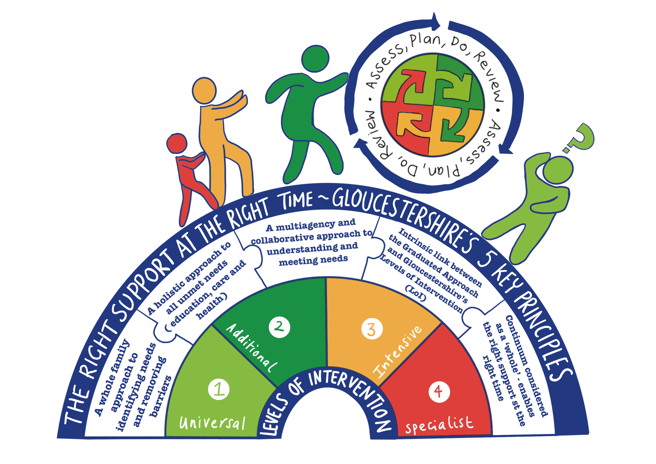
- Universal;
- additional;
- intensive; and
- specialist
Each level provides for a solution-focussed approach to meeting needs at the earliest opportunity, with the most appropriate and least intrusive level of intervention. It’s a graduated evidence-based approach - all relevant approaches at the lower levels have been tried before involving services that provide a more intensive approach.
Levels 1-3
Early intervention can identify the need for additional support through the use of the Graduated Pathway.
Level 4
Specialist interventions, involving statutory assessment and planning (including Education Health and Care Plan (EHCP), Child in Need (CiN) Plan, Child in Care (CiC) Plan, Child Protection (CP) Plan).
Unmet needs identified as part of the Graduated Pathway process should be transferred into the statutory (Level 4) process’s when a family is stepped up to Child in Need (CiN) or Child Protection (CP) Plan.
In practice this means:
- Unmet needs should inform the Statutory Assessment process
- Work being undertaken should be included in and contribute to the CiN or CP Plan
- The community Lead Practitioner should hand over their responsibility for oversight to the allocated Social Worker for the length of the Social Care involvement
- As a child/ young person / family steps back down to Level 3 (Intensive) support, unmet needs should be transferred back from Statutory to Graduated Pathway process’s informed by the social care involvement.
- The EHC Plan model instead utilises the My Plan Plus to breakdown key level objectives into smaller steps and to support unmet needs that sit outside of general key level specific targets included in the statutory EHC document.
- When a child / young person is taken in to the care of the Local Authority a Graduated Pathway plan should be closed and needs should be incorporated into the Care Plan and/or Personal Education Plan (PEP). The suitability of a new Graduated Pathway plan should be considered by the lead practitioner when a child/ young person leaves care.
- When that Child in Care is in receipt of an EHC Plan the My Plan Plus will still need to remain active alongside the Care Plan / PEP.
- Where multiple plans are in place for a child/ young person/ family, every effort should be taken to ensure that they are reviewed by the same group of professionals at the same time. i.e. For a child/ young person in care with an EHCP the My Plan Plus and Care Plan/ PEP are reviewed three times a year, best practice would dictate that these reviews took place in the same meeting, with every third meeting also incorporating a full EHC Plan review.