
The 4 Stages of Positive Risk Management
12. The 4 Stages of Positive Risk Management
This diagram represents the stages of the risk management process – not the stages of the self directed support process.
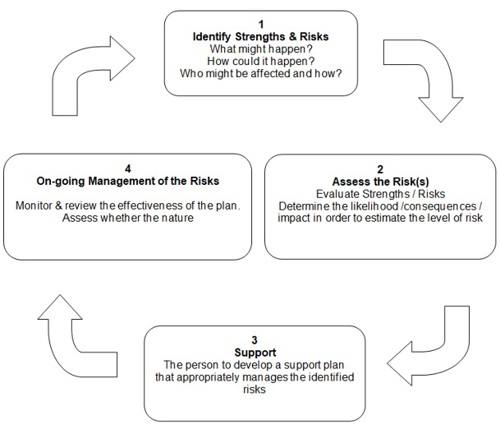
12.1 Stage 1 - Risk Identification
12.1.1 When considering risk, practitioners should refer to the Prioritising Needs (formerly known as FACS) criteria where the question is posed “What is the risk to loss of independence or greater loss of independence if nothing is done? Three of the four assessment domains are particularly important in this context: health and safety, autonomy, and involvement in family and wider community life (including leisure, hobbies, unpaid and paid work, learning and volunteering). Local authorities are also required to assess risk to the carer.
In Gloucestershire we have declared that people will be eligible for social care support when they face Critical or Substantial risks of not being able to achieve outcomes such as:
- Exercising choice and control
- Health and well being, including mental and emotional as well as physical health and well-being
- Personal dignity and respect
- Quality of life
- Freedom from discrimination
- Making a positive contribution
- Economic well-being
- Freedom from harm, abuse and neglect, taking wider issues of housing and community safety into account
12.1.2 The assessment process is the main opportunity to identify risk but it is important that information is gathered from a number of sources to provide a good basis on which to make an assessment of risk:
- Past records
- Assessments and reviews using Prioritising Needs (FACs) criteria
- Discussions with the person to identify risks that are recorded within the assessment meeting(s) using the FACE overview
- Reports from significant others e.g. carers, family friends and other involved professionals
- Observing discrepancies between verbal and non-verbal cues
- Predictive indicators derived from research
- Judgements based on evidence based practice
- Feedback from existing providers who are delivering services to support the person
12.1.3 All evidence that is gathered must be recorded using the FACE assessment toolkit in order to demonstrate how the decision regarding the level of risk was reached.
12.2 Stage 2 - Risk Assessment
12.2.1 We have a duty to take reasonable care to avoid any action or omission in which it could be reasonable to foresee that the likely result would be harm or loss to the person needing support, carers, staff or the general public.
12.2.2 We also need to ensure that safeguarding concerns are identified and appropriately managed at every stage of the assessment, support planning and co-ordination of services, and that practitioners understand their responsibilities in the safeguarding adults procedures.
Multi agency safeguard policy and procedures | Safeguarding Adults in Gloucestershire
12.2.3 Risk assessment is the process of gathering information in the variety of ways described in 12.1.2 i.e. it is the adult care assessment process. This process should be a dynamic, on-going process that manages the information in a way that is meaningful and can be communicated with individuals and carers and practitioners who deliver those services. To be effective it needs staff to collaborate with people and their carers to arrive at appropriate and creative decisions about risk when devising a support plan.
12.2.4 Assessors are prompted to score the identified risks on the FACE overview form (the score should reflect the assessors judgement (and this must be supported by documented evidence) of likelihood of occurrence and severity of impact). Assessors are required to record and score the risks related to health and safety, autonomy, and involvement in family and wider community life (including leisure, hobbies, unpaid and paid work, learning and volunteering).
12.2.5 During the assessment process the following must be considered and/or achieved:
- The perception and understanding of risk by the person and their carer
- The mental capacity of the person
- That past behaviour tends to inform future behaviour
- The need to collect accurate information from people and their carers and identification of any
concerns or issues that may increase the probability of an event occurring - The strengths and abilities of the person along with any support or advocacy services open to them. This gives a positive base from which to develop the assessment
- A person-centred approach to identify, assess and manage risk
- The distinction between the long and the short term. A short term heightened risk may need to be tolerated and managed for longer term positive gains
- Taking risks can give some people confidence
- The assessment needs to be clear if it is to protect the person or others
- Where possible, all involved agencies and the person should agree on the approach to risk and how identified risks will be controlled
- Consensus helps to support positive risk taking
- Any documents that record risks and control measures must be signed and dated by all involved parties and they must include a review date
- Where somebody involved in the support plan or the provision of support does not agree with the assessment, that their concerns and reasons are recorded
- That the learning from any previous instances of harm is considered and should be included in the assessment.
12.3 Stage 3 - Support Positive Risk Management
12.3.1 Risk management is the activity of exercising a duty of care by introducing control measures in conjunction with the person concerned when risks are identified. This is the main purpose of the support planning processes and should involve preventative, responsive and supportive measures to reduce the potential negative consequences of the risk and promote the potential benefits of taking appropriate risks. Decision making in relation to risk must always be clearly documented by the support planner and reviewed periodically. Please see A Guide to Adult Assessment in Gloucestershire.
12.3.2 Support Planners must be careful that any risk management strategy is proportionate and any response devised in the support planning stage should relate to the type of arrangements the individual chooses.
12.3.3 Where a risk assessment is needed (not all domains will present issues), a decision then has to be taken about whether or not positive risk-taking is necessary to achieve certain outcomes for the person concerned, but this has to be determined in partnership with the person affected, and their family where appropriate. It is a professional judgement that should not be influenced by an overly cautious approach to risk. At the same time though, positive risk-taking is not negligent ignorance of the potential risks – nobody benefits from allowing risks to play their course through to disaster.
12.3.4 Managers / supervisors have a key role to play by recognising that there is joint accountability for risk decisions and hence they should be involved in signing off all support plans. They are responsible for ensuring that their supervision style is conducive to staff being supported to take risk decisions and staff are confident that they will be supported and treated fairly if an incident occurs. A practitioner should engage the support of their manager to review the progress of support plans where the levels of risk are deemed to be high and decisions should be recorded and signed off by the Community Manager and where appropriate the Locality Panel or Locality Manager.
12.3.5 This approach supports an individual’s right to make informed decisions about the care or support they receive. It recognises the concept of empowerment when working with vulnerable people. Where the individual lacks capacity consideration must then be given as to how their best interests can be met. If an IMCA needs to be involved, then instruction for an IMCA needs to be made, otherwise consideration should be given to the provision of an advocate to help represent their views.
12.3.6 Positive risk taking needs to be under pinned by contingency planning which will help to prevent some harmful outcomes and minimise others. Risk taking should be seen to promote opportunities and safety and not negligence. Therefore all the involved parties should consider what steps need to be taken in the event of a failure of the risk management plan.
12.3.7 Where people are behaving recklessly, support plans may include the setting of explicit boundaries to contain situations that are developing into potentially dangerous circumstances for all involved. For further information see the Managing Complex and Unstable Care Packages Policy.
12.3.8 Where people are considered to be at risk of abuse from others then an alert needs to be raised via the Gloucestershire County Council Adult Social Care Help Desk on 01452 426868 or socialcare.enq@gloucestershire.gov.uk
For advice on safe guarding adults you can contact the Safeguarding Adults Advice Line on 01452 425109.
For safeguarding adults procedures go to:
Multi agency safeguard policy and procedures | Safeguarding Adults in Gloucestershire
12.4 Stage 4 - On-going Management of the Risks
12.4.1 Initial, planned and response reassessments are the mechanism for reviewing risks and the control measures (the support plans) introduced to manage them. They must be set to take place as a way of monitoring whether or not the actions or measures agreed in the support plan are happening and that the risks are maintained at the agreed level.
Last reviewed: