
Health
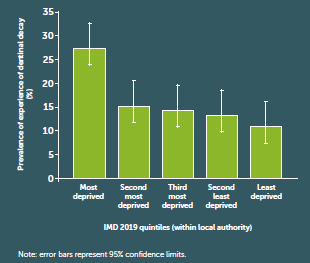
Overall Gloucestershire tends to perform well against England averages for indicators such as levels of immunisation, breastfeeding rates and oral health, however these mask disparities that exist based on deprivation and ethnicity. For example, the proportion of 5 year olds experiencing dental decay in Gloucestershire is significantly lower than the England average (16.8%) however the prevalence in the most deprived areas of Gloucestershire is almost three times higher than in the least deprived.
Figure 3: Prevalence of experience of dentinal decay in 5 year olds in Gloucestershire, by local authority Index of Multiple Deprivation (IMD) 2019 quintiles.
Benchmarking data shows that we have a higher proportion of admissions to hospital for some childhood illnesses and injuries, this needs further investigation but is in part due to hospital policies on when to admit children and the way data is coded.
Obesity affects 1 in 5 children in year 6 and is a major public health concern. Nationally, the  prevalence of obesity among children living in the most deprived neighbourhoods continues to be more than double that of those in the least deprived areas. There are also ethnic differences with rates highest amongst Black children and lowest for Chinese children.
Positively, the Pupil Wellbeing Survey 2022 has found that the amount of exercise young people are doing has been increasing steadily since 2018, improvements were also seen in healthy eating habits with an increase in the proportion eating 5 a day and a reduction in sugary and energy drink consumption.
The proportion of pupils reporting drinking alcohol has also been steadily declining, and the proportion reporting trying illegal drugs fell between 2020 and 2022. The proportion of pupils reporting that the relationships and sex education they have received has been helpful had increased and the majority of young people who reported having intercourse reported they used a condom.
Last reviewed: