
What the COVID-19 pandemic taught us about social connection
We know that healthy and meaningful social connections are essential for good health and wellbeing. Whilst social-distancing and self-isolation was needed to protect ourselves and others, these interventions impacted our day-to-day relationships and led to a much-documented increase in loneliness.
The organisation ‘Campaign to End Loneliness’ reported that between April 2020 and February 2021, one million more adults across the UK had become chronically lonely, disproportionately affecting young people, people living alone, people on low incomes or unemployed and people with mental health conditions.[i]
Within Gloucestershire, up to 38,000 people (the vast majority aged 70 years or above) undertook ‘shielding’
at one point or another during the pandemic. Even for those that didn’t shield, there was a huge reduction in
availability of social spaces and social opportunities, even outside periods of lockdown. In Gloucestershire,
the number of referrals to the Community Wellbeing Service due to isolation and loneliness peaked between December 2020 and February 2021, quite possibly linked to the effects of the pandemic.
Friends are of particular importance to the development of an individual’s identity and provide vital support. Removing opportunities from children and young people to socialise with their peers appears to have contributed to feelings of loneliness amongst children and young people in Gloucestershire. Roughly a third of students that completed our Pupil Wellbeing Survey during 2021-22 indicated that the pandemic had adversely affected their wellbeing.[ii]
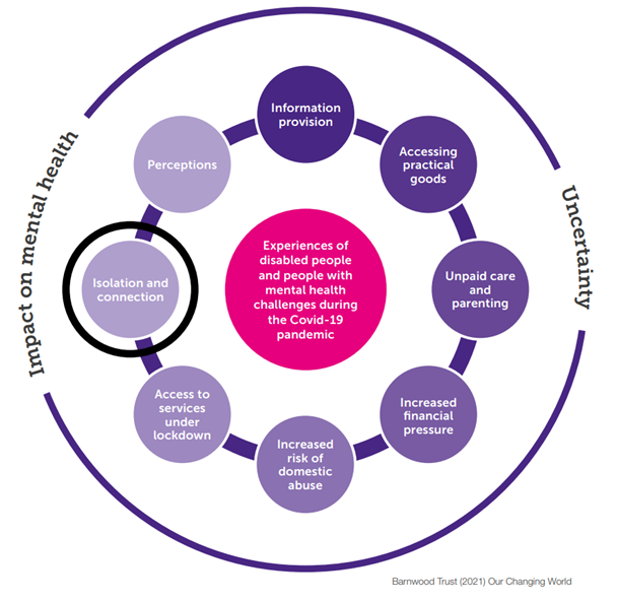
Locally charity, ‘The Barnwood Trust’ published a report in 2021 entitled ‘Our Changing World’. This report explored the experiences of people in Gloucestershire with disabilities during the earlier periods of the pandemic, clearly identifying that isolation was exacerbated as relationships that were relied on to help manage day to day were restricted or altered.[iii]
The impact on wellbeing for people at risk of loneliness is likely to be compounded by other economic and social impacts experienced by the same people, such as those experiencing job losses and health anxieties.
According to UK government figures, one in four people in employment during the coronavirus (COVID-19) pandemic had been on furlough at some point between March 2020 and June 2021. Furthermore, single working parents were particularly affected, as 31% of them were furloughed, compared with 24% of workers living as a couple with dependent children.[iv]
Whilst the negative impacts are significant, the pandemic has in many ways been a catalyst for community cohesion. Many people discovered opportunities to maintain or make connections with neighbours and others within the local community. This included the internet and other digital technologies, turning previously face to face meetings such as book clubs and choirs to online sessions.
Those with birthdays in the lockdown periods came up with new ways to celebrate virtually. And millions of children were part of online classrooms, learning in ways we did not think of before the pandemic began.
The pandemic has reminded us of the importance and vast benefits of connecting, emphasising how essential social networks, friends, family and communities are to our wellbeing and happiness. This report focuses on how individuals, communities and organisations in Gloucestershire can, and do, enable meaningful social connections throughout the county.
- [i] Campaign to End Loneliness (2021) Beyond Covid-19 (available from Loneliness beyond Covid-19 | Campaign to End Loneliness) [accessed on 01/08/2022]
- [ii] Gloucestershire County Council (2022) Pupil Wellbeing Survey report (available from Pupil Wellbeing Survey (formerly Online Pupil Survey) - Inform (gloucestershire.gov.uk)) [accessed 01/09/2022]
- [iii] Barnwood Trust (2021) Our Changing World (available from https://www.barnwoodtrust.org/news/our-changing-world) [accessed 03/08/2022]
- [iv] Office of National Statistics (2021) An overview of workers who were furloughed in the UK: Labour Force Survey) [accessed on 01/10/2022]
- [i] Campaign to End Loneliness (2021) Beyond Covid-19 (available from Loneliness beyond Covid-19 | Campaign to End Loneliness) [accessed on 01/08/2022]
- [ii] Gloucestershire County Council (2022) Pupil Wellbeing Survey report (available from Pupil Wellbeing Survey (formerly Online Pupil Survey) - Inform (gloucestershire.gov.uk)) [accessed 01/09/2022]
- [iii] Barnwood Trust (2021) Our Changing World (available from https://www.barnwoodtrust.org/news/our-changing-world) [accessed 03/08/2022]
- [iv] Office of National Statistics (2021) An overview of workers who were furloughed in the UK: Labour Force Survey) [accessed on 01/10/2022]
Last reviewed: