
What is Natural Flood Management?
As the twin crises of climate change and the loss of nature increasingly impact the world around us, we know we must do everything we can to find solutions that will help our communities adapt to increased flooding whilst restoring our ecosystems to their fullest potential.
Natural Flood Management (NFM) describes the process of restoring the natural function of our river catchments, with the aim of increasing communities' resilience to flooding. Some NFM measures are taken in or next to the river itself, such as leaky dams, reconnecting rivers with their floodplains or even beaver reintroductions. Others operate in the wider river catchment like sustainable soil management or tree planting. Taken together they can reduce and delay flood peaks in communities downstream whilst contributing multiple other benefits including carbon sequestration, biodiversity improvements and cleaner water. Crucially, this makes NFM very good value for money when used in conjunction with traditional engineered flood schemes.
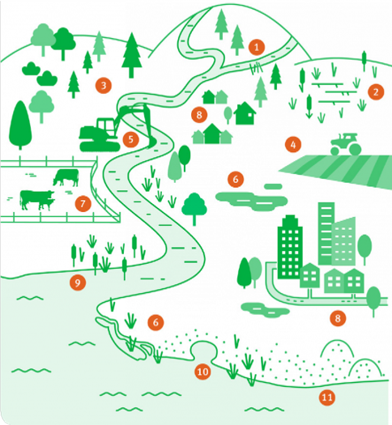
The diagram below taken from the National Flood and Coastal Erosion Risk Management Strategy for England shows how NFM works within the landscape:
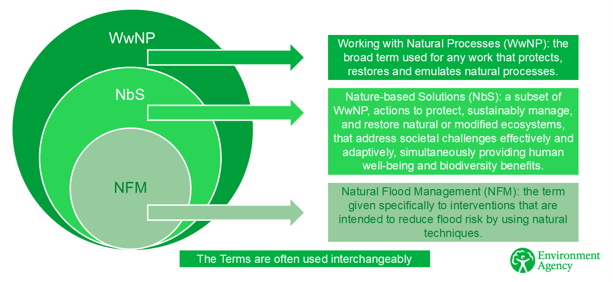
There is a lot of different terminology used when describing NFM and similar types of approaches - from 'Working with Natural Processes' (WwNP) to 'Nature Based Solutions' (NbS) or even 'Blue Green Infrastructure'. We have found the following diagram produced by the Environment Agency useful at showing how NFM fits into this bigger picture, highlighting NFM's primary driver - the reduction of flood risk:
National Natural Flood Management Team – Environment Agency
Last reviewed: